Buongiorno,
cerco più notizie possibili su una minari che ha partecipato al Car Show di Bruxelles .
Grazie a chi mi può aiutare
-
PIETRO.LUPINO
- Newbie

- Berichten: 5
- Lid geworden op: vr jan 09, 2026 16:19

-
PIETRO.LUPINO
- Newbie
- Berichten: 5
- Lid geworden op: vr jan 09, 2026 16:19
Re: alfa romeo minari
I want to know if this member rlodewijkx82 is active in this forum or not, because now i'm the owner of his car and i'm searching information about the engine and other stuff, if someone can help me!
-
Alfa Romeo Miniatura Fer

- Guru

- Berichten: 1043
- Lid geworden op: zo dec 04, 2005 21:37
- Locatie: Capelle aan den IJssel
- Contacteer: Website
Re: alfa romeo minari
an article i wrote some years ago.I want to know if this member rlodewijkx82 is active in this forum or not, because now i'm the owner of his car and i'm searching information about the engine and other stuff, if someone can help me!
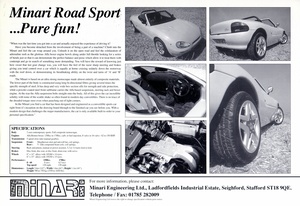
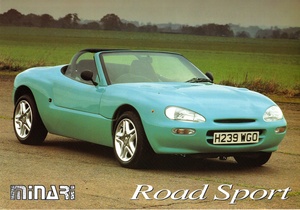
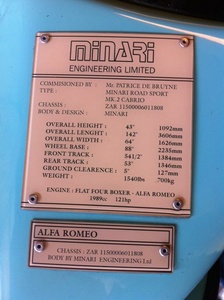
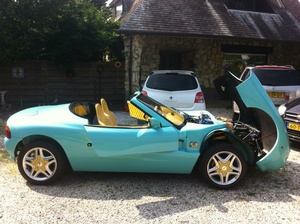
The Alfa Minari was never produced by Alfa Romeo itself, nor was it commissioned by the factory and built by recognized coachbuilders such as Bertone or Zagato. The Minari was built by an English kit car manufacturer, Minari Engineering Ltd. from Staffordshire. A small factory founded by Sean Prendergast and Andrew Borrowman, two British engineers who decided to build a sporty two-seater together.
The first examples of the Minari were presented in 1990 and were entirely based on the Alfa Sud under the skin. Not such a crazy idea: the Sud had an excellent chassis, a nice boxer engine, and good steering and handling. However, the bodywork of the Suds disappeared in no time due to a lack of rust resistance. Minari replaced that bodywork with a fiberglass body that bore the closest resemblance to a Mazda MX-5. A small spider that, with a bit of imagination, also brought to mind the Fiat Barchetta and the BMW Z1. Unlike that last car, however, the doors opened sideways, rather than sliding downwards.
But as mentioned: under the skin, the Minari was initially an Alfa Sud. Only about a dozen examples of the first MK1 version (also known as the ClubSport) were built. The little car offered only limited protection against harsh weather conditions; the windows had to be clipped into the doors. Nevertheless, it was intended as a serious car: the prototype was tested by the factory for 20,000 miles in severe conditions.
The second series of Minaris (known as the MK2 or RoadSport) quickly switched to the Alfa 33 in terms of technology, the qualitatively better successor to the Sud. The MK2 version received the necessary under-the-hood reinforcements, swivel windows, and a rounder nose and rear. Approximately 130 examples of this model were built until production ceased in 2000. In total, therefore, fewer than 150 Alfa Minaris were produced.
The Minari was a true kit car, in the best English tradition. Across the Channel, quite a few small factories have emerged as kit car builders over the past decades—and just as often, they have ceased to exist. Think of Marcos and Ginetta, and many buggy and Mini converters. But also sports car manufacturers like TVR, Lotus, and Morgan, all of whom started by offering kit cars.
The self-assembly version of the Minari RoadSport was offered by the manufacturer at the time starting from 24,000 guilders. A ready-made Minari RoadSport was to cost around 38,000 guilders. The exact price depended heavily on the customer's wishes, as a Minari could be delivered fully custom-made, in all possible configurations and with many accessories. Incidentally, a significant portion of the later Minaris were built at Chameleon Cars, a British dealer that supplied ready-made Minaris particularly in the second half of the 1990s. The body was formed by a composite plastic monocoque, which, as mentioned, utilized the mechanical and technical parts of the Alfa Sud, the Alfa 33, or the Alfa (Sud) Sprint. Powering the low-slung Minari were therefore the flat and piercingly fierce boxer engines familiar from the Sud; ranging from 1300 cc with a twin carburetor to 1700 cc 16-valve injection. In addition to the engine, the gearbox, front and rear suspension, brakes, steering, wheels, fuel tank, wiring, dashboard instruments, and other components also came from a donor Sud or 33. The headlights and taillights, however, came from Mazda (from an MX-3 and a 121, respectively), which explains the resemblance to the MX-5. The windshield was from a Citroën AX. A true cut-and-paste kit car, then, but a tasteful one nonetheless, with a nice interior and handy features such as the hood that hinged completely forward, which made maintenance much easier. Enthusiastic DIY builders could also choose to receive a more or less extensive parts package from Minari Engineering. The basic package (priced at the time as £2,950) included, among other things, a tubular frame, roll bar, subframes, sheet metal, and springs. The body panel package (£1,371) included the hood, bumpers, doors, and tailgate. In addition, items such as locks, windows, lights, interior trim, sports seats, mirrors, seat belts, and a mohair soft top were naturally required. For a sum of around £7,000, someone with good hands could build their own Minari, provided a donor Alfa Sud or Alfa 33 with good mechanics was already available. A trip to the paint shop was not included in that amount, as the panels were supplied bare.
The Minari RoadSport received appreciative reviews from the trade press. Magazines such as Performance Car, Cars & Car Conversion, and Kit Cars International Magazine were positive about its driving qualities. The monocoque structure provided significant rigidity. Combined with the low weight (over 700 kg) and correspondingly low center of gravity, this gave the Minari excellent handling and true sports car performance. The boxer engine fit the concept perfectly, and the build quality was also considerable, with neatly fitting components. The Minari RoadSport was therefore rightly touted as ‘pure fun’, not only for the road but also for the track. For the latter purpose, Minari also offered several special RSR versions: without a windshield and optionally available with an even lighter carbon fiber body.
For Sale
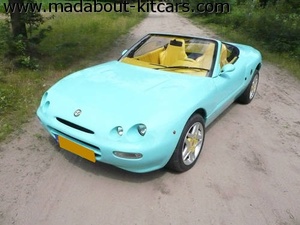
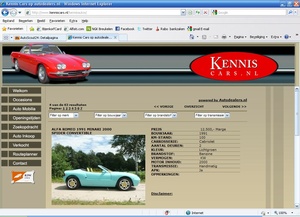
The board at the time rightly pointed out a lack of type approval at the RDW. But that last point should have been resolved. After all, there is currently at least one Alfa Minari for sale with Dutch license plates, specifically at Kennis Cars in Valkenswaard (www.kenniscars.nl). The light blue-green Minari with light brown-yellow upholstery featured in this article is that particular example: a 1991 RoadSport, with (remarkably!) a 2-liter engine. According to the Kennis Cars website, the car costs €12,500. (in 2013).
SCARB no 00575
Alfa Romeo Registro Miniatura, since 1992.
http://alfaromeominiatura.nl
Alfa 147 2.0 Cup trackday
Alfa Giulietta Sprint Speciale 1.4 TCT 2016 rosso
*driving Alfa Romeo since 1975.
Alfa Romeo Registro Miniatura, since 1992.
http://alfaromeominiatura.nl
Alfa 147 2.0 Cup trackday
Alfa Giulietta Sprint Speciale 1.4 TCT 2016 rosso
*driving Alfa Romeo since 1975.
-
Hylke
- Moderator
- Berichten: 6780
- Lid geworden op: za feb 19, 2005 15:43
- Locatie: Hoevelaken
- Contacteer: Website
Re: alfa romeo minari
19 juni 2014 was his last visit to this forum, so you could consider him inactive.I want to know if this member rlodewijkx82 is active in this forum or not, because now i'm the owner of his car and i'm searching information about the engine and other stuff, if someone can help me!
Il silenzio notturno è stato disturbato bruttamente dalla musica del mio cuore sportivo!
Giulia 2.0 ‘18
R Nine T '21
Giulia 2.0 ‘18
R Nine T '21